
One of the cool things I’ve learned while studying communication is how people absorb information. Throughout the years we have Every so often we develop new technology – the printing press, the internet – that revolutionizes communication. Scholars have even broken these technologies into eras, which I compiled into a nice little infographic below.
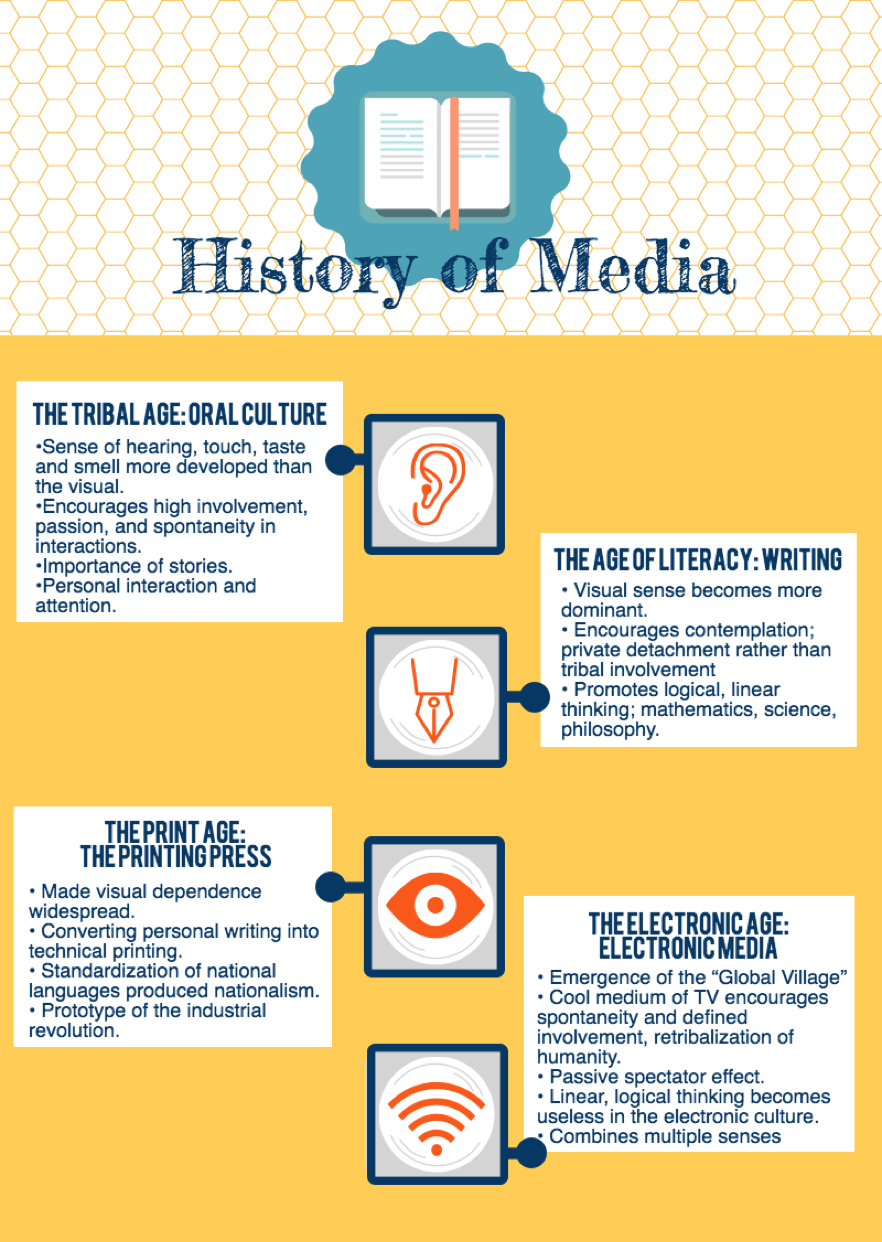
Experts like good ole Marshall Mcluhan believe that the channel we use for information helps determine the structure of society. A part of that is what senses we use to consume information. A long time ago in a tribal village far far away, people we using oral tradition to pass down history and societal norms. We relied on our ears Gradually we, mostly the church and rich people, learned to write and began using our eyes more for information. Then yada yada the printing press was invented,and mass communication was born. Television was revolutionary because it combined sight and sound.
Basically we started from the bottom now we’re here.
The main point is, with the inception of the internet and convergence of digital technology, communication technology is stimulating more of our senses at once to keep us interested in the message.
Given alllllllll that information, it is no wonder that VIDEO is one of the biggest trends in social media.
According to a report by Cisco, video will account for 80 percent of global internet traffic by 2019, meaning nearly a million minutes of video shared every second.
Facebook says the number of video posts on their site has increased 94 percent in the U.S. just last year. The Financial Times also reports that Snapchat has tripled its video views since May 2015. Of course YouTube is still the leader in video (for now). They say the number of people watching video on their site has increased by 40 percent since 2014, with the number of hours watched increasing by 60 percent.
Hootsuite predicts more video growth in the coming years, and a battle between YouTube and Facebook for the top spot in views.
Relating back to comm. theory, I’m wondering how long these videos are and what it will take to keep the ever-demanding consumers’ attention span. How will video change society? More online classes? Let’s business travel because of video conferencing? Or is there something bigger we’re still waiting for???

I think all of this is fascinating, because it fits right in with the evolution of media I’ve had loved to study the past four years.

 jaykayferguson.com